Monday, July 30, 2018

Frederic Chopin's Nocturne Opus 9 No. 1 (Take Two)

I recorded myself playing the Chopin Nocturne once again, this time on the Boston, which has better action on the keys. I'm happier with this recording.

I hope you have a good night.


- F

Sunday, July 29, 2018

The truth will set you free, but not before it's finished with you."

I'm reading Sarah Bakewell's book At The Existentialist Cafe (2016) in preparation for a book discussion I will be joining on August 4th (if time allows. That's the same day Dan and I are going to get our marriage certificate!). The book is absolutely fascinating, helpful, and informative. Review to come.

Just a few nights ago I learned what I thought was just a rumor before - that one of my favorite philosophers, Martin Heidegger, was a supporter of the Nazi party before and after WWII. This, as written about with striking objectivity in Bakewell's book, turns out to be evidentially true - and not only that, but he was a declared member of the Nazi Party. I read parts of Heidegger's most famous work, Being and Timeyears ago as an undergrad. I really loved it. Can I still go back to it, get something out of it, and appreciate one of my favorite philosophical treatises now having the knowledge that it's writer later joined the Nazis? 

As a graduate student I discussed something similar. Prior to writing his quirky and fun children's novels, Dr. Seuss created racist cartoons. Can I still read Dr. Seuss through a clear, objective lens now that I have the knowledge of his previous political views? 

I think not. 

(This brings up an even bigger question of authenticity.)

If an artist's work is honest and truthful, not hiding anything (even in the most abstract form), then I believe it can be appreciated for that very idea of honesty, truthfulness, authenticity. But, if the artist is hiding, obscuring, or even unconsciously portraying questionable ideas that emerge (sooner or later) in his or her work, then the art immediately becomes contextualized within social, political, and economic values of production. And isn't artistry at it's highest when it can be free from these boundaries? This is why self-deprecating artists are, most of the time, appreciated and more easily "forgiven" (think Woody Allen and comedians like Louis C.K.).

Both Heidegger and Dr. Suess were "in the closet" (please excuse my language) about their politics, especially Dr. Seuss. And later in his life, Heidegger wasn't even attempting to deny his affiliation with the Nazi Party. However, this was less clear in his philosophical work. His views were subtle and never direct (except within The Black Notebooks, which were published last, and which contain stomach-churning words by Heidgger). 

How is directness achieved in art? That's rhetorical. Directness in art, no matter the form or content, is so crucial to authenticity, I would say that this "directness" is almost, if not as important as skill itself. I might go back to that later... 

(Honestly, I wasn't big on Dr. Seuss as a child. It was Behelman's Madeline, The Very Hungry Caterpillar, and then The Baby Sitter's Club. His sense of humor didn't sit well with me as a child - I'm more likely to laugh at his books now than I was then! Even knowing what I know!)

I'll end with this quote from one of the great fiction writers of our time, David Foster Wallace:

"The truth will set you free, but not before it's finished with you."
- F

Monday, July 23, 2018

Frederic Chopin's Nocturne Opus 9 No. 1

I finally have been able to record Chopin's Nocturne Opus 9 No. 1 in full, without too many mistakes. The music, when I began to play this piece again, was super abstract at first, and as I practiced more and more, the piece began to remind me of a bird, a soaring bird, and I think that image helped me improve my interpretation of it.

I'll keep improving on this piece, always. Here it is for now:


- F

Wednesday, June 6, 2018

Involuntary dilation of the iris?"


- F

I am the Dark Man's Sooty Brother and my King as well."

I am being given permission, by an author who knows damn well that he's right in what he's talking about in his deconstruction and analysis of a fabulous fairy-tale, to symbolically do what I've been wanting to do for ages:

"One has to be active. Boil them."


"...notice who places shame on you - that's one way of boiling."


Both passages from "More Than True: The Wisdom Of Fairy-Tales". I loved reading this book. Review to come, which will be posted on my other blog: www.feliciareviewsbooks.blogspot.com

- F


Wednesday, May 30, 2018

The Ignorance of Intelligence


You never know until you're told. Or, you never know until it happens to you.

Then you know better. Better enough to walk away, to stay quiet, to help, to learn, to dig deeper, to choose words (to speak, to write) and to act on what you really meant - before you knew. 

(Thanks for letting me know. And thanks for letting me experience it.)

Continuous effort, not strength or intelligence, is the key to unlocking our potential. 
- Winston Churchill 

Sincerely,
F

Tuesday, May 22, 2018

Notes & Thoughts On the 2018 Brinson Lecture: “Let There Be Light: The Observational Quest For The First Galaxies”

"The motivation is fundamental: the origin of starlight begins the process of chemical evolution which ultimately leads to our own existence in this remarkable Universe.” – from the pamphlet description of 2018’s Brinson Lecture


A week or so ago, I received a notice from work informing me of the 2018 Brinson Lecture which took place just a few days ago on Thursday, May 17. The lecturer, Richard Ellis, an astrophysics professor at the University College London, came all the way to the School of the Art Institute of Chicago’s MacLean Ballroom to talk about new studies regarding the development of the first galaxies. One would think – right when the Big Bang happened, right? Whenever that was.


Though I arrived about thirty minutes late due to unexpected high traffic, I was still able to pick up on about five percent of Dr. Ellis’s lecture. That would have probably been the same amount of understanding I would have got if I had arrived early. Dr. Ellis was kind enough not to underestimate his audience, which, I think, is something that happens much too often at lectures of this type. However, in a ballroom that was about fifty percent full, I’m not sure how much of the audience was on the same page as Ellis, let alone the same (or vaguely the same) profession. I sat behind a man who began snoring midway through one of my favorite parts of the lecture, and who, after the lecture was over, upon his waking, did not hesitate to fill his plate up with free lecture food. But… I digress.

When I walked in, the screen had some sort of map on it, which I could not read. In terms of science, I will admit that I am fairly illiterate, and sadly so. Yet, I was not discouraged. Dr. Ellis’s energy, enthusiasm, and pride in his work and in his students was immediately felt, keeping, I think, most of the audience from walking out due to incomprehension.


What I gathered:

1.      Light – that is, light that illuminates so we can see – appeared 250 million years after the Big Bang. It didn’t just show up immediately – it took time for atomic gas to transform into what we call light. Dr. Ellis explained how they figured this out, which was fairly recently (I couldn’t grasp this part, unfortunately).


2.      There are now telescopes with cameras that can photograph the forming of galaxies in *real time* (or as close as we can get to it). One photograph showed the forming of seventy-five (or more) galaxies forming all at once. When I heard this I gasped loudly – I had no idea that the forming of galaxies was still happening, let alone the forming of seventy-five at oncee, let alone the fact that this can be photographed! (Hearing this was my favorite part of the lecture.)


3.      Three facilities the general public should know about which carry the highest, best telescopes: European ELT (which stands for Extremely Large Telescope – no joke), the Giant Magellan, and the Thirty Meter Telescope (TMT).


4.      Young stars can be seen with ultra-violet light, and older stars can be seen with optical light (but I didn’t grasp the importance of these facts).


5.      There is such a thing called Interstellar Dust. Interstellar Dust is produced by exploding stars (dying stars). Interstellar Dust then absorbs starlight and then begins to glow. We now can measure the age of galaxies by some of radiation from the dust.


6.      The universe has always been expanding. But new discoveries show that the universe is expanding faster than ever before, and the rate is only increasing. Which means, our future is very, very dark, as galaxies get farther and farther apart. No one knows why the universe is expanding faster. We do know that this “darkness” won’t happen for billions of years.


7.      A career in astrophysics is unlikely. But studying astrophysics can lead to other careers in the STEM program. One brilliant student that Dr. Ellis saw graduate went to Wall Street, for example, because although he didn’t find a job in his specified field, he was much needed for his analytical expertise, etc. over there. I also think being able to do astrophysics requires a bit of talent – it seems to me that a mind has to be “tuned” into that kind of thinking in order to want to pursue it.

8. Scientists to know, and know well: Albert Einstein, Arthur Eddington, and Edwin Hubble.

All in all, I had a fantastic time at the lecture. It was not a surprise to me that there were only three simple and short questions from the stunned audience at the end.

I absolutely loved this quote that Dr. Ellis put up on his last slide, from Mr. Edwin Hubble (of the Hubble telescope):

“At the last dim horizon, we search among ghostly errors of observations for landmarks that are scarcely more substantial: The search will continue. The urge is older than history. It is not satisfied and it will not be oppressed.” – from Edwin Hubble’s book “The Realm of the Nebulae”

- F

Sunday, May 6, 2018

Last Sunday at the Arboretum

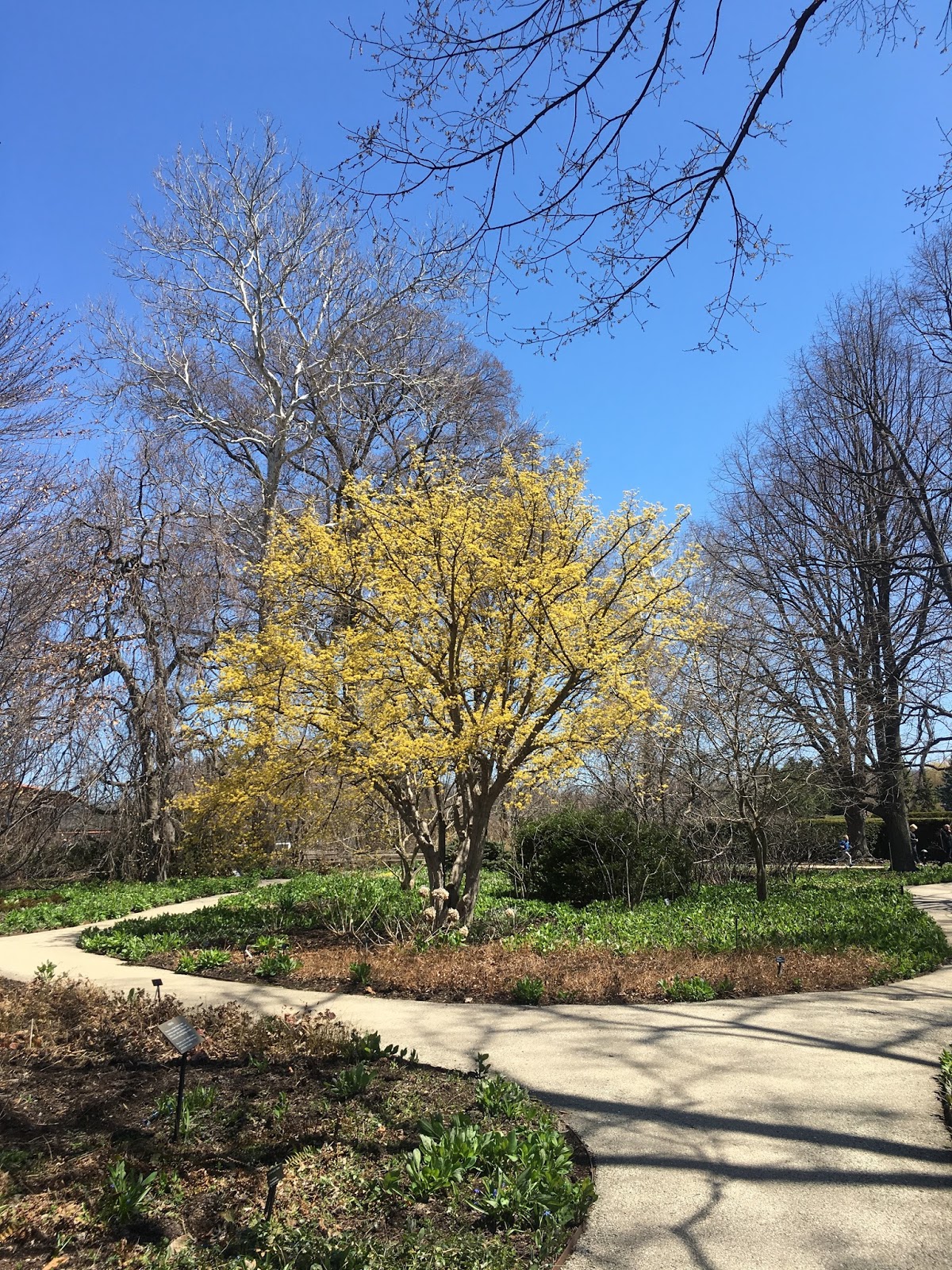
Last Sunday, Dan and I visited our favorite place: The Morton Arboretum. With each visit, the Arboretum becomes more of a special place in our hearts. It has been a place for us to be with one another without the distractions of our normal routine closer to the city. It has been a place for us to learn about nature together. To learn about trees, plants, animal life, and culture. It has been a place for us to feel kinship with the animals and trees and strangers. It has been a space for us to be peaceful, to reflect, to talk, to laugh, to walk... it has been our own bit of "Walden" perhaps.

As we entered the grounds that Sunday, birdsong immediately filled our ears with pleasant conversation. We started with a stroll around one of the lakes, Meadow Lake, and a friendly bird chirped with a very unique sound that echoed throughout the Meadow, as if to greet all the passers-by, saying s/he was, like us, happy too.


(I would like to learn more about birds. I have a feeling that I might, if Dan and I continue to seek out nature they way we do now. If we make it a habit. I think we will.)

As we made our way around the lake and further into the land, a squirrel came begging for scraps. It was adorable. It begged as if it were little puppy. This isn't typical of squirrels around our neighborhood, who seem to be so frightened of human interaction and scurry away quickly as soon as our bodies with their shadows and shoes approach. But this Arboretum squirrel was not afraid in the least.


When I dropped a few of my chocolate-chip cookie crumbs, this squirrel didn't hesitate to run up to Dan and I and munch, munch, munch. It was less than a foot away from us; we could have pet it. Maybe next time. But we did name this particular squirrel Gus-Gus.


We continued to walk, coffees in hand, the energizing liquid warming our throats and palms amidst the cool breeze. The sun shined above us, it's light gently warming our faces. The trees, waking up from winter slumber, seemed to yawn pleasantly as they slowly awoke from dormancy, and our quiet footsteps became gentle and unhurried. In the quiet of nature, we calmed ourselves together, and spoke of how thankful we were for this day. 


The flowering trees had already begun to sprout the new buds of flowers and the scent was intoxicating, filling us with some strange promise of renewal. And I realized that I agree with T.S. Eliot. April is indeed the cruelest month, forcing the world to melt and break and to begin growing once again, the warmth gnawing at it's outside, it's shell and skin and fur and bark, after a long winter of resting in the comfort of within. April says, it's time to come out and face the world fully, no hiding. But if April is cruel in this way, it is it's ending, its transition into May, that is sweet. Less cruel, more confident, and steady, steady, steady. 


In the dead of winter of this year, we went to a Forest Therapy Walk. One of the lessons we learned is that every tree has a story. If you study it, just by looking and listening, you could make one up yourself. This time we came upon a particularly interesting tree, which grew up and up and up from the same roots and stump, yet split, early on in its journey upwards, into two different trunks. It's foundation, however, remains one and the same. I might be inspired to write a story about this tree sometime, some comment on solitude and respect, or on the ability for there to be two individual parts of one complete whole. Something connected from its beginning, separated during the middle, only to meet once again at the highest points.


I found a meadow and I wanted to sit it in it, so we did. I like meadows. Illinois has a lot of them, these big expanses of grass. Lots of room for running and reading and sleeping. For sitting and for meeting. 


This museum of trees, this place where trees from all over the world are brought to be saved, to be bred, to be studied, to be taken care of, is not a place free from its inherent wilderness. Actually, since it is a place where the wild knows it can be safe, it becomes a kind of Eden for both plant life and animal life. Deer hide deep in the woods of the Arboretum, turtles thrive in it's lakes and ponds (we saw one large turtle sunbathing on a rock in the middle of the lake, and then a family of about five on another rock, sunbathing as well), squirrels beg for chocolate-chip cookies, birds of all kinds fly over it, fish splash around... and so death must also be a part of its ecosystem.

Dan and I explored the grounds off the regular path (which is allowed) and found a skeleton. A goose, maybe. 


Maybe a wolf killed it over the winter and the body, covered in snow, was never found by the Arboretum scientists. Maybe the birds ate all the meat heartily. I wonder now if anyone will "clean" it up off of the ground. 

When Dan and I explore here, we don't talk as much as we do elsewhere. Our chatter subsides and we are really with each other. We see each other and we feel close. I'm really excited about learning the science of trees and plants and animals here with him. When we can start naming things. When we can start bringing more of it's essence home (which we already do).


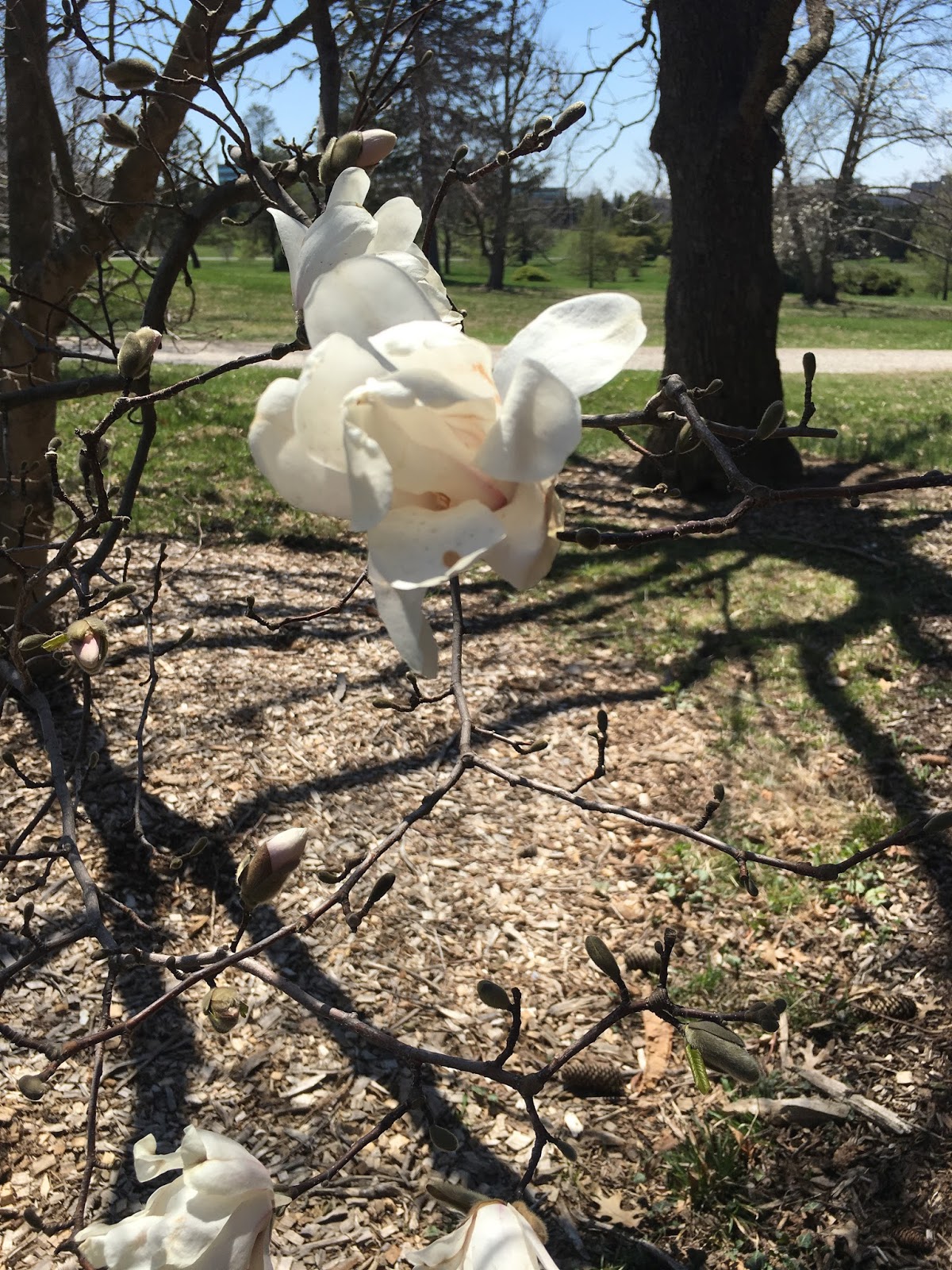
The fragrant magnolia tree...! Medicine for our minds.


After a few hours of exploring, Dan urged me to take the Tram Tour. I didn't want to. It was too quiet and calm... but he convinced me and so we did. I didn't regret it one bit. 


We learned about the man who made this amazing place, Joy Morton. The same guy who is the name of Morton Salt! The same man whose father created Arbor Day in the United States. That's the man who created this wonderful space where we will be celebrating our marriage. We learned how huge the place is, we found the library, we saw collections of evergreens and more lakes and collections of different types of flowering trees... we found out that the Arboretum is trying to create spaces that actually recreate what Illinois would have looked like before the colonies. Prairies. Forests. 

More to come. 

- F 

Friday, May 4, 2018

Berceuse

"May your dreams bring you peace in the darkness
May you always rise over the rain
May the light from above always lead you to love
May you stay in the arms of the angels"

                             by Masaaki Sasamoto                                            by Regina Sczesc Mehr


- F


Saturday, April 28, 2018

Notes and Thoughts on Chicago Ideas Week Curiosity Series: "Navigating Modern Tech Ethics: An Evening With Facebook"

Last Thursday night, I attended a program hosted by Chicago Ideas Week as part of their Curiosity Series. The program was titled: Navigating Modern Tech Ethics: An Evening With Facebook. I was offered a free ticket to this program through my job at the Harold Washington Library Center and I took it. It was well worth the time and effort to get to the Museum of Contemporary Art (MCA), sit for an hour and a half, and listen, because they covered a lot of things that I feel have been on our collective minds right now. It was apt that the moderator began with something like this: "It takes a lot more than dragging Mark Zuckerberg to Congress to understand what really is going on here." True.


Anil Dash did a excellent job moderating the program by asking direct, difficult questions and keeping an great sense of humor the entire one and a half hours. The two interviewees were Margaret Gould Stewart, Vice President of Product Design for Facebook, and Sudhir Venkatesh, Research Manager for Facebook (also the author of the book Gang Leader For A Day).

A lot of Anil Dash's questions centered on three topics: the ethics of data collection (as well as advertising), responses to social media's effects on society as a whole (specifically in terms of addictive behavior), and Facebook's organizational culture. As might be supposed, the need for proper transparency was a thread that ran through most of Stewart and Venkatesh's responses. While Facebook does have a clear policy available to all users, it still seems that many of it's two billion+ users (which, they made sure to note, was the population of the entire world in the year 1930) are not cognizant of the fact that Facebook is indeed a for-profit company. That being said, Facebook still holds itself accountable to use proper practices in order to extend the "lifespan" of their business. Basically, improper practices are simply not good for business; i.e. building a business model focused on getting users to stay on their devices for as long as possible is not a good business model because it, in the long run, will aggravate users as well as impair mental health.

I am aware, and was aware during the time of this presentation, that I was listening to employees of Facebook. Thus, I didn't expect them to sit there and talk s&^% about their gazillion dollars worth employer. However, it seemed that some people in the audience did. One woman laughed loudly when Venkatesh stated that many of the employees at Facebook are very self-critical and are not lacking in humility. The nature of Facebook, as stated by these two employees, is that it is inherently an interdisciplinary business. Stewart gave a perfect example by using the model of a quadrant.


On the far right end is all the numbers, the data, the particles, the atoms; all the coding stuff. On the far left is the "atmosphere" of Facebook, it's visual presence, it's online environment, it's interface. At the very top is society and at the very bottom is the individual user. The crosshair in the middle is the product. This is a huge ecosystem. Sociologists work with coders who work with graphic designers who work with engineers, who work with computer scientists who work with researchers, and the list goes on. The very fact of the business having so many people working together from different disciplines makes it unique in a very positive way (there is less to say about the backgrounds, demographics, ethnicity, gender, sexual orientation, etc. of the company - which is something they seem to be aware of). One thing that Dash pointed out was the fact that they used the term society - not community - because it is now known that Facebook affects not only it's users but also non-users in different, but very big ways.


I was a bit perturbed by the people in the audience who just could not stop looking at their phones during this interview, and especially concerned when the topic turned to the abuse of apps like Facebook, Snapchat, and Instagram and they still did not put their phones down. So yeah, there is a real addiction to "staying connected" on social media. How does Facebook respond to this? Well, Stewart and Venkatesh honed in on the fact that there is a lot of ethnocentrism to these questions. Think about where the questions are coming from, they urged. The Western Hemisphere, Europe, the United States. While our concern is addiction to apps, the company, at this socio-political juncture, cannot make policy changes regarding how to use the app - that would be making an assumption on two billion people and counting. The question, rather, should ask: what is going on in our society right now, and what is our society's relationship to technology? Stewart made clear that staring at our phones continuously is simply not sustainable. "We'd better not be doing that in five years" was something like what she quipped to us.

As for advertising, their answer was simple. Facebook is free because of the advertising companies, not to mention that Facebook is the best way for small businesses to grow (as data shows). Facebook wants to keep it's service free (part of their philosophy is open access), thus they keep the advertisements. They have found no way around this - though they claim they have tried. This led to the conversation on the ethics of data collection. When humantarian groups asked them for data in order to help a population suffering from a natural, socio-political, or other type of disaster, they had to wrack their brains on whether or not to pull that data out. These humanitarian groups were the Red Cross, the PeaceCorps, and others. After deliberation, they decided to do it. If their data could help save lives, then they would use it. That was Facebook's decision. According to them, they keep all of the data anonymous/private.

There was one point in the program that I realized that I trusted Facebook because of how f%$#@!@ stupid and naive they are. Pardon my language, but this one story was unbelievable. You may remember Facebook's "Year In Review" service, where they pulled photos and status's from each user's year and created a montage with super cheesy music so everyone could see a compilation of the great year they had. When one of their employees saw his recently deceased daughter's face as the first picture of the montage, all the while the happy music playing in the background, he notified everyone immediately. On the other end of this, I personally have seen hilarious "Year in Review" montages where my friends are drinking themselves to death, playing lonely music alone and clearly sad, taking pitiful selfies, and much worse - all the while this extremely happy tune plays that sounds like something out of a commercial for pills that combat depression.

The fact that Facebook didn't realize while making this product that not ALL people have great, wonderful, happy-go-lucky lives every year was astounding. The level of assumption that Facebook had to make in order to produce such a ridiculous service is just plain and simply naive of the company. Suffice it to say, going from an Ivy-League based product to a world-wide one was and is an eye-opening experience for many of the longest employees of Facebook. They admit their mistake.

When asked how accessible Mark Zuckerberg is to the lower ranks of the company, they claimed he is very accesible. They have a whole-company meeting each Friday, where Zuckerberg gets grilled by tough questions and presented with dense situations the entire time. For a company that huge, a meeting each Friday with the big boss seems pretty damn good.

An artist drew this while the program was running. I saw her up at the front, sketching away. It was left outside the theater when the program ended:


- F

Pigeons

Either they ate too much junk - spilled popcorn and Cheetos spilled over the abandoned alleyways - or instead consumed some sort of poison a...